DJI FlyCart 100: cargo drone with up to 85 kg of payload
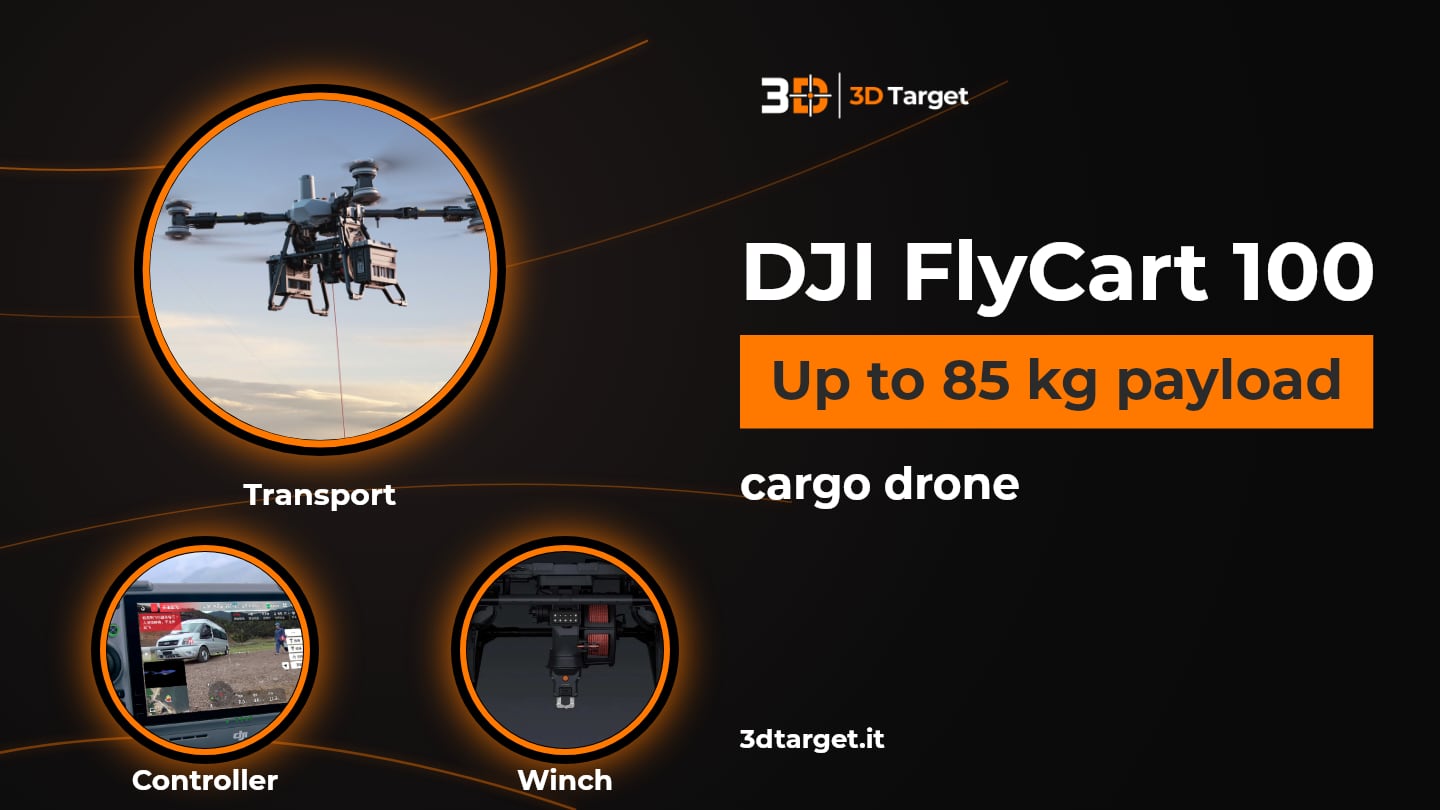
If you are looking for a cargo drone to carry materials and equipment where roads do not reach, DJI FlyCart 100 is the system to know. It is a DJI delivery drone with a maximum takeoff weight of 170 kg and up to 85 kg of payload with dual battery, two cargo systems (Winch and Lifting), sensing systems and a built-in parachute.
On this page we explain how it is built, what changes between the two cargo systems and what the numbers mean for anyone organizing transport at altitude, in remote areas or over water. The data are those declared by DJI: for availability, configuration and pricing, 3D Target is at your disposal.
DJI FlyCart 100 at a glance
| Feature | Data declared by DJI |
|---|---|
| Maximum payload | 85 kg (with dual battery) |
| Maximum takeoff weight | 170 kg (150 kg in Brazil, Japan, Australia, Turkey, Saudi Arabia and Argentina) |
| Aircraft weight | 55.2 kg with Lifting system, 60.2 kg with Winch system (excluding batteries, battery compartment, accessories, cable and hook) |
| Speed | 20 m/s horizontal; ascent and descent 5 m/s |
| Flight with dual battery at 149.9 kg | 14 minutes of flight, 12 minutes of hovering, 12 km |
| Operating altitude | 6,000 m above sea level, 1,500 m relative to the takeoff point |
| Protection and temperature | IP55, -20 °C to 40 °C |
| Wind in takeoff and landing | Up to 12 m/s |
| Dimensions | 3220 × 3224 × 975 mm with arms and propellers unfolded; 1105 × 1265 × 975 mm folded |
| Cargo systems | Flagship Winch (0-30 m cable) or dual-battery Lifting (10 m cable), both with weighing |
| Batteries and charging | DJI DB2160 / DB2212, 41 Ah, 52 V; C12000 power supply up to 12,000 W, 30% to 95% in 9 minutes |
| Transmission | DJI O4, up to 20 km (FCC), 12 km (SRRC), 10 km (CE/MIC) |
| Remote controller | TKPL 2 with 7-inch screen and DJI Delivery App |
Flight times and distances refer to the 149.9 kg takeoff weight stated by DJI in the datasheet: with different loads and conditions the values change. In Europe the CE transmission figure applies.
How much payload does DJI FlyCart 100 carry
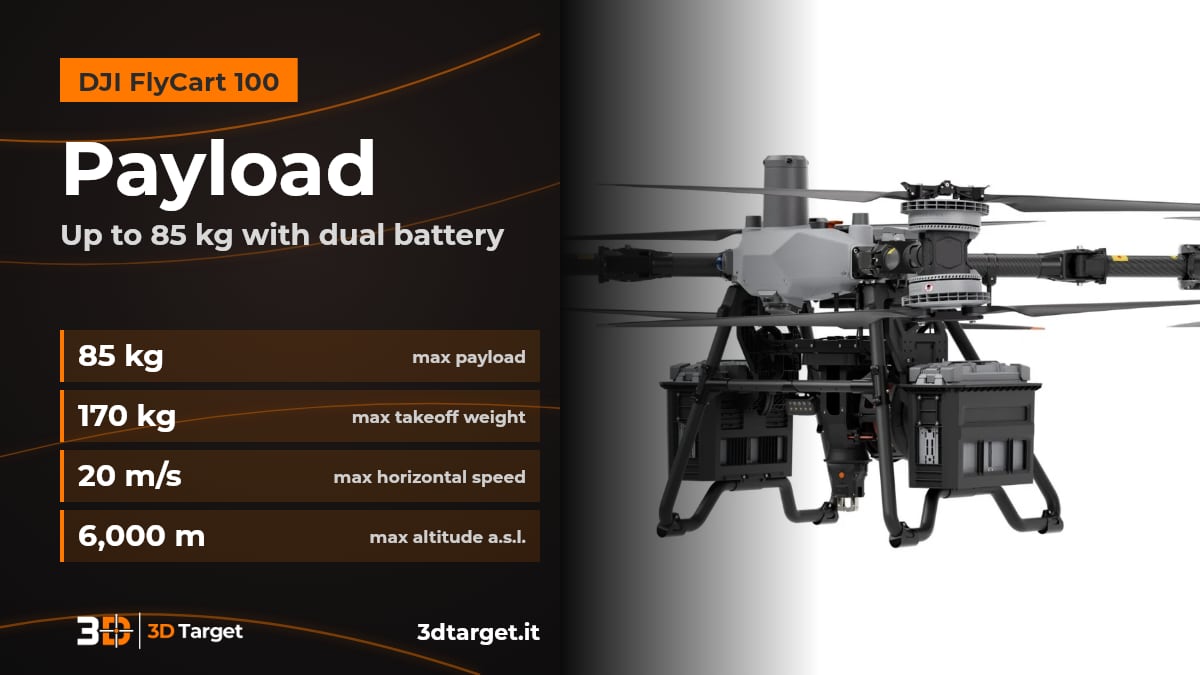
DJI FlyCart 100 lifts up to 85 kg of payload with dual battery, with a maximum takeoff weight of 170 kg. With the single battery, which DJI intends for emergencies only, flight drops to 7 minutes and 6 km.
Powerful structure: 62-inch carbon fiber folding dual-blade propellers, paired with motors with a 155 × 16 mm stator.
Speed: 20 m/s horizontally, while ascent and descent are at 5 m/s.
Altitude: it operates up to 6,000 m above sea level and 1,500 m relative to the takeoff point.
Easier transport: arms and propellers fold, and the footprint goes from 3220 × 3224 mm to 1105 × 1265 mm.
You choose it when the load is heavy and the road is long, difficult or nonexistent: the drone carries the material in place of a person on foot or a ground vehicle.
Ask for advice on DJI FlyCart 100
Winch or Lifting system: which one to choose
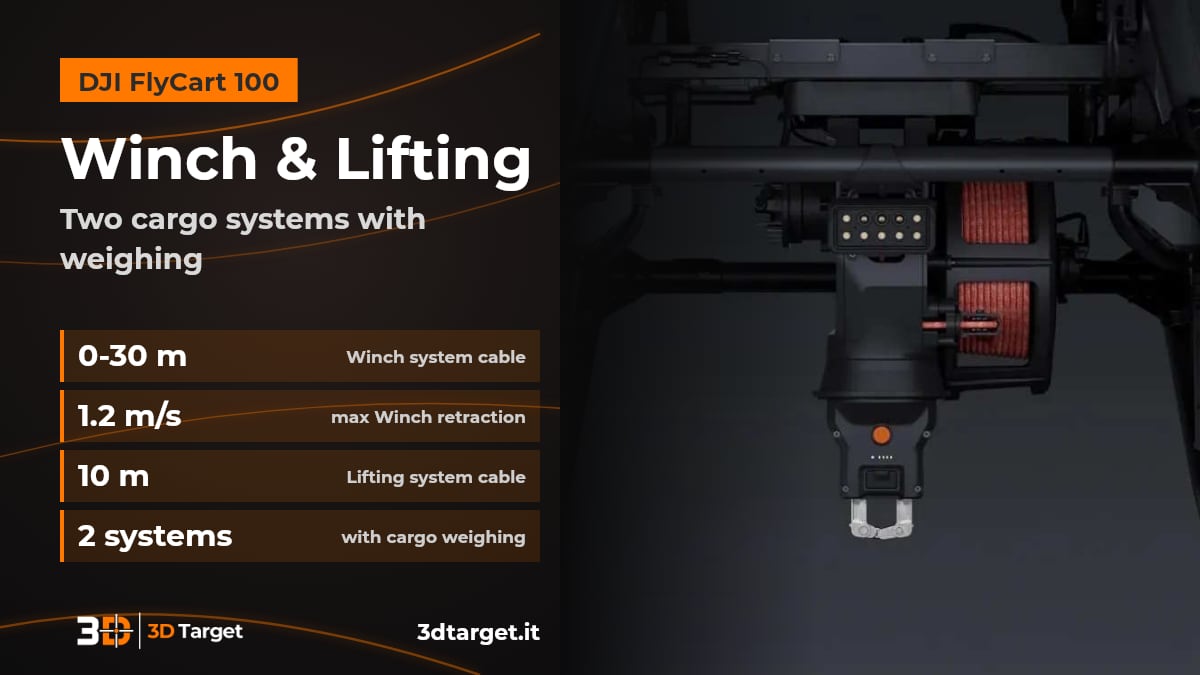
The Winch lowers the cargo on a 0 to 30 meter cable; the Lifting system uses a 10 meter cable. Both weigh the cargo, but they differ in cable length and way of working.
Flagship Winch (A2EWH-100A): 0 to 30 m cable, retraction up to 1.2 m/s, cargo weighing and a hook that opens from the app or with a button. It offers one-tap release and retraction, intelligent deceleration protection, cable discard escape and wireless or Type-C hook charging, with 10 hours of power supply.
Dual-battery Lifting (A2EDL-100A): 10 m cable, with a recommended length of 10 to 15 m, cargo weighing, automatic balance control and a cable cut emergency escape mode.
Dimensions: each system measures 960 × 805 × 669 mm.
The Winch offers the longest cable (up to 30 m), the Lifting a 10 m cable: the choice depends on the load and the site, and we discuss it together.
Safety: radar, LiDAR, Quad-vision and parachute
DJI FlyCart 100 uses radar, LiDAR and 360° vision to detect obstacles and a built-in parachute for emergencies. These systems assist the pilot, but real flight conditions always depend on weather, regulations and the operator's assessment.
Obstacle sensing: front millimeter-wave radar, rear and downward radar, LiDAR and Quad-vision system. The measurement range is 60 m.
360° view: the Quad-vision system covers 360° horizontally and 180° vertically; the FPV camera has a field of view of ±86° horizontally and 108° vertically.
E2MSF-100A parachute: opens manually or automatically from a minimum height of 100 m and brings the aircraft down at 7 m/s. It has IP55 protection and signals opening with a buzzer and lights.
Lights: forward and downward lights up to 46 W, with automatic or manual control.
Accuracy: with RTK enabled, hovering accuracy is ±10 cm horizontally and vertically.
Batteries and 9-minute charging
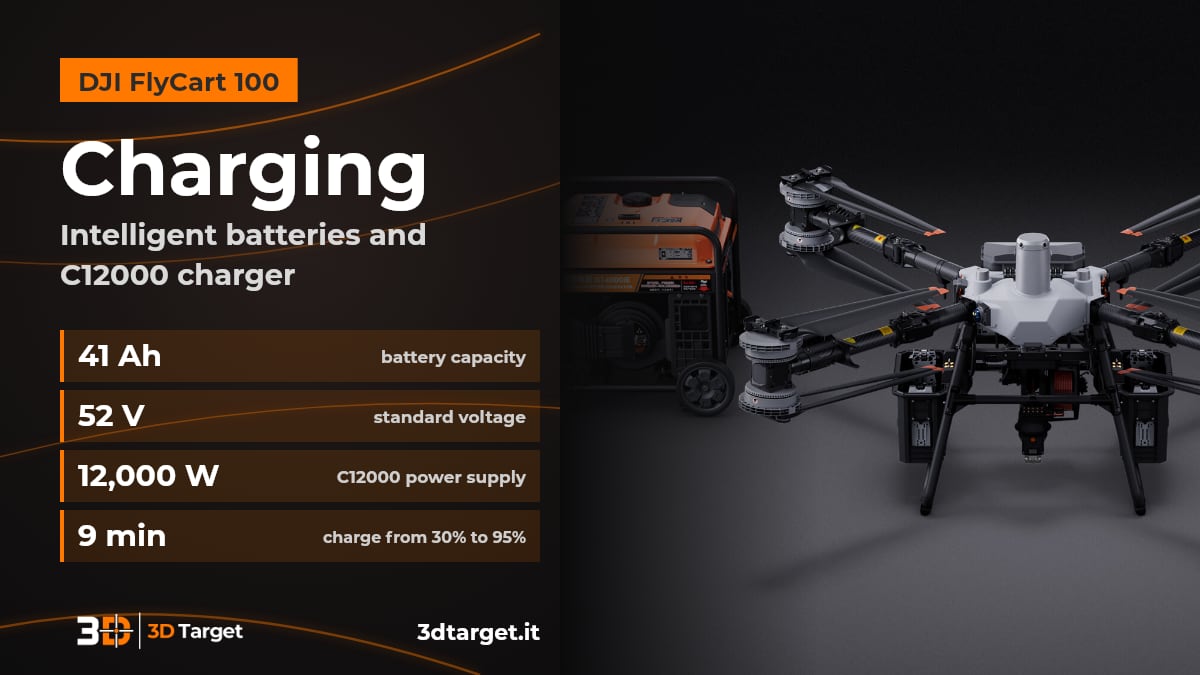
The DJI C12000 power supply charges the batteries from 30% to 95% in 9 minutes. The DB2160 and DB2212 intelligent batteries have a capacity of 41 Ah and a standard voltage of 52 V, and weigh about 15 kg each (14.7 kg and 15 kg).
C12000 power supply: up to 12,000 W with a 380 V three-phase input (3,000 W with 220 V single-phase), with over-temperature, over-voltage, under-voltage and short-circuit protection.
Input: three-phase AC 175-520 V or single-phase AC 200-264 V.
Optional generator: among the accessories DJI lists the D14000iE inverter generator with a 30 L tank.
Remote controller, transmission and software
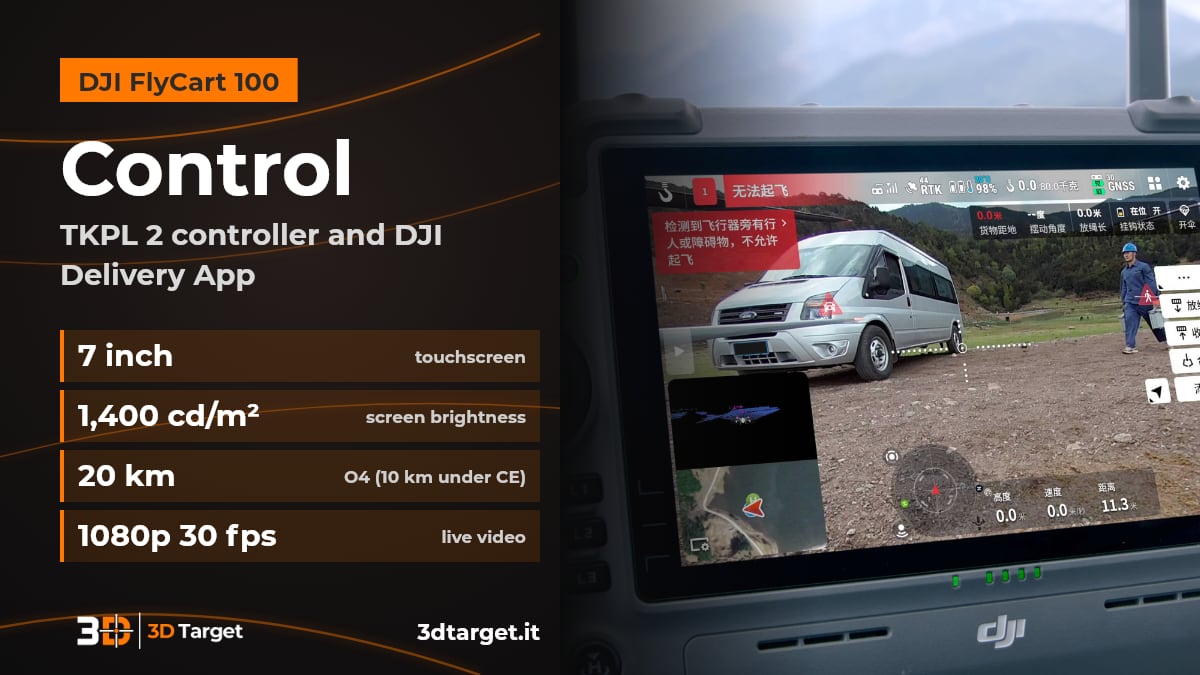
DJI FlyCart 100 is flown with the TKPL 2 remote controller and the DJI Delivery App, designed for delivery missions. The link uses DJI O4 transmission, with live video at 1080p and 30 fps, and is backed by 4G enhanced transmission for the hardest areas.
Screen: 7-inch touchscreen, 1,400 cd/m², works from -20 °C to 50 °C, with built-in RTK module and enhanced 4G.
Distance: up to 20 km under FCC, 12 km SRRC and 10 km under CE/MIC.
Controller battery life: 3.8 hours with the built-in battery, 3.2 hours with the external one.
Dual operator: two people work together, each with their own controller (the second one is sold separately).
PSDK: the Eport-Lite interface connects third-party payloads, with a power interface up to 3000 W. The DJI FC100 PSDK Connection Cable Combo is sold separately.
Flight log: an independent memory stores the data of 10 flights; accessories also include the optional D-RTK 3 station.
Where it is used
DJI lists courier and transport, engineering, emergency, energy, public safety, landscape and water transport as application areas for FlyCart 100: deliveries in areas ranging, in the manufacturer's words, from mountains to oceans.
You can find more drone applications on the drone applications page and other models in the enterprise drones catalog.
With 3D Target you are not alone in the field
Consulting: we help you understand whether DJI FlyCart 100 suits your load, your site and your type of mission.
Trial and demonstration: ask to see the system in action.
Training: courses to use drone and software, such as the DJI Advanced GEO Products Training courses.
Support: technical assistance after purchase.
Integration: our R&D department works on custom solutions.
Discover all 3D Target services. For the official specifications you can also see the DJI page dedicated to FlyCart 100.
Frequently asked questions
What is DJI FlyCart 100?
It is a DJI cargo and delivery drone. It has a maximum takeoff weight of 170 kg, carries up to 85 kg of payload with dual battery and is configured with the Winch system or the Lifting system.
How much payload does DJI FlyCart 100 carry?
Up to 85 kg of payload with dual battery. The maximum takeoff weight is 170 kg (150 kg in some countries, such as Brazil, Japan, Australia, Turkey, Saudi Arabia and Argentina).
How long and how far does it fly?
With dual battery at a takeoff weight of 149.9 kg, DJI declares 14 minutes of flight, 12 minutes of hovering and 12 km. With a single battery, for emergencies only, 7 minutes and 6 km. Values change with load and conditions.
What is the difference between the Winch and Lifting systems?
The Winch has a 0 to 30 m cable with retraction up to 1.2 m/s. The Lifting system has a 10 m cable (10-15 m recommended) and automatic balance control. Both weigh the cargo.
What happens in an in-flight emergency?
The aircraft has an E2MSF-100A parachute, with manual or automatic opening from a minimum height of 100 m and touchdown at 7 m/s. The single battery is intended for emergencies only.
How much does it cost and how do I order?
We work on quotation. Write to info@3dtarget.it or call +39 030 5357677, or use the contact page.
Do you have a load to transport?
Tell us what you need to transport, where and how often: we will tell you whether DJI FlyCart 100 is the right solution and how to get started.
Technical data are those declared by DJI on the manufacturer's website and in the DJI FlyCart 100 datasheet and may vary. For up-to-date data, ask us for confirmation. DJI is a trademark of its respective owners.